For twenty years, being visible online meant one thing: showing up in Google’s ten blue links. Today, some of your future clients put their question to ChatGPT, Gemini or Perplexity and read a written answer in which only a few sources are cited. Two disciplines now work together: SEO, to be found in search engines, and GEO (Generative Engine Optimization), to be understood and cited by answer engines.
Key point. GEO does not replace SEO. Google says so itself: there are no additional technical requirements to appear in its AI answers. A page must first be indexed and useful. GEO adds clarity on top.
Contents
SEO: what does not change
The SEO foundations are the same. A site Google cannot crawl, that takes six seconds to load on mobile, or whose pages all look alike will be neither ranked nor cited. Before talking about AI, check three SEO basics:
- Indexing. Are your important pages in Google’s index? Search Console tells you page by page.
- Speed and mobile. Google assesses real visitor experience through Core Web Vitals.
- Useful content. Text written to answer a real question, by someone who knows the subject.
What changes with answer engines
An answer engine does not return a list, it composes a paragraph. To do so, it splits your page into passages and keeps the ones that answer the question plainly. Three practical consequences.
The answer must fit in a few sentences
A passage that starts with the answer and then backs it up is easier to reuse than a ten-line introduction. Write each section as if it had to be read on its own.
Your business must be identifiable
Who are you, where do you work, for whom, since when? This information must be written plainly on the site and repeated identically wherever your business appears: directories, social networks, your Google Business Profile.
Structured data removes ambiguity
Schema.org markup describes your page in a machine-readable format: an organization, a service, a question and its answer, an article and its author. It guarantees no ranking, but it prevents misreadings.
The six SEO and GEO workstreams, in order
| Workstream | What we do | Helps SEO | Helps GEO |
|---|---|---|---|
| Architecture | One page per service and per search intent | Yes | Yes |
| Technical | Speed, mobile, sitemap, canonical tags | Yes | Yes |
| Content | Direct answers, examples, sourced figures | Yes | Yes |
| Structured data | Organization, Service, FAQPage, Article | Yes | Yes |
| Identity | Same name, address and description everywhere | Locally | Yes |
| Measurement | Search Console, tracking of enquiries received | Yes | Partly |
Do you need an llms.txt file?
The llms.txt file is a proposed standard: a plain-text summary of your site intended for language models. Adoption by the major players is uneven and Google does not ask for it. It is cheap to set up and does no harm, but it replaces none of the six workstreams above.
Where to start
On the SEO side, start with what is most often missing: separate service pages, a title and description specific to each page, and written answers to the questions your clients already ask you. That is exactly the work we build in from the design stage in our SEO and GEO offer. If your site already exists, tell us about your situation and we will show you where the quickest gains are.
How Google discovers and ranks a page
SEO starts long before ranking. Google works in three stages. It first crawls the web by following links and sitemaps. It then indexes the pages it finds useful, meaning it stores their content. Finally, for each search, it ranks indexed pages by relevance and quality. A page that is not in the index cannot appear anywhere, whatever SEO work has been done on it.
Three simple checks tell you where you stand:
- Type
site:yourdomain.cominto Google to see which pages are known. - Open the “Pages” report in Search Console to read the reasons for exclusion.
- Make sure your robots.txt file does not block a whole section by mistake.
Google itself states that the effect of an SEO change can show within hours or take several months. Nobody can honestly promise you first place by a given date.
Keywords and search intent
Good SEO is not about repeating a phrase. It is about understanding what the person really wants when they type their search. Four intents are usually distinguished:
| Intent | Example search | Page to offer |
|---|---|---|
| To learn | “what is GEO” | An article or a guide |
| To compare | “Shopify or WooCommerce” | An honest comparison |
| To buy or order | “website design Cotonou” | A service page |
| To find a brand | “Aureva Digital” | The home page |
A service page that tries to answer an informational search ranks poorly, and the reverse is true too. The most profitable SEO rule is therefore simple: one page, one intent, one clear promise in the title.
Where to find the right phrases
Your customers already give them to you. Reread your WhatsApp messages, your emails and the questions asked in meetings. Add Google’s suggestions, the “People also ask” box and the Search Console performance report, which lists the real searches that lead to your site.
Local SEO, decisive for a business on the ground
If you welcome customers or serve a specific city, local SEO weighs as much as the site itself. Three things count.
- Your Google Business Profile. It is free and feeds Google Maps and the local block in results. Fill in the category, opening hours, photos and service area.
- Consistent contact details. Name, address and phone must be written the same way on the site, the Google profile, Facebook and directories.
- Reviews. Ask satisfied customers for them and reply to each one, including the negative ones.
For a business in Cotonou, Abidjan or Dakar, local SEO is often the fastest way to get calls, because competitors rarely take care of these three points.
Structured data in practice
Structured data is a shared vocabulary, Schema.org, added to the code of the page. It changes nothing for the visitor, but it tells search engines and AIs what the page contains. The most useful types for a business site:
| Type | What it is for |
|---|---|
| Organization or LocalBusiness | Identifying the business, its address and phone |
| Service | Describing a service and the area served |
| FAQPage | Pairing each question with its answer |
| Article | Stating the author and date of a piece of content |
| BreadcrumbList | Showing where the page sits in the site |
An SEO plugin such as Rank Math generates much of this markup on WordPress. Google’s Rich Results Test then lets you check that it is read correctly. Markup must always describe what is actually visible on the page: marking up content that is not there goes against Google’s rules.

Writing to be cited by an AI
GEO extends SEO on one precise point: the way you write. An answer engine reuses short, self-contained, verifiable passages. A few writing habits make the difference.
- Start each section with the answer, in one or two sentences.
- Give figures with their source and year.
- Define technical terms the first time you use them.
- Prefer lists and tables for comparisons.
- Sign your content: who writes, with what experience.
Google sums this up in four criteria it asks its quality raters to consider: experience, expertise, authoritativeness and trust. These are not technical settings. They are proof to show: past work, method, an identifiable author, real contact details.
SEO for a site in several languages
A site in English and French doubles your chances of being found, provided it is marked up properly. Each page needs its own address per language, and an hreflang tag linking the two versions. Without it, Google may show the English version to a French-speaking visitor, or treat the two pages as duplicates.
Two mistakes come up often in multilingual SEO: translating the text but leaving the title and description in the other language, and redirecting visitors automatically by location, which stops Google from crawling every version.
Measuring what SEO brings in
Without measurement, SEO stays an impression. Search Console, which is free, gives four figures per page and per search: impressions, clicks, click-through rate and average position. Read together, they tell you what to do.
| What you see | What it means | Action |
|---|---|---|
| Many impressions, few clicks | The title is not appealing | Rewrite the title and description |
| Position between 8 and 20 | The page is close to page one | Enrich the content, add internal links |
| No impressions | The page is not indexed or off topic | Check indexing and intent |
| Clicks but no enquiries | The page does not prompt action | Rework the call to action |
The figure that matters in the end is not the position. It is the number of enquiries the site sends you each month.
The SEO mistakes we see most often
- A single page for every service. Google does not know which search to show it for.
- Identical titles. “Home” or the company name repeated on every page says nothing about the content.
- Heavy images. They slow the site down, especially on a mobile connection.
- Text inside images. Neither Google nor AIs read it properly.
- A rebuilt site with no redirects. Old addresses lead to errors and the SEO you had earned disappears.
- Content written for a robot. Forced repetition shows and drives the reader away.
Links, internal and external
Links remain one of the signals Google uses to understand a site. There are two kinds, and the first depends entirely on you.
Internal links connect your own pages. They tell Google which pages matter and what they are about. Three simple SEO rules: every important page should be reachable in three clicks at most from the home page, the link text should describe the destination rather than say “click here”, and every article should point to the matching service page.
External links, the ones other sites make to yours, have to be earned. Honest ways exist: being credited by a client whose site you built, appearing in the directory of a professional body, publishing content useful enough to be quoted. Buying links in bulk breaks Google’s rules and ends up costing more than it brings.
Speed, an SEO workstream in its own right
A slow page loses visitors before it has even been read, and Google takes it into account. The biggest gains almost always come from the same actions.
| Action | Effect |
|---|---|
| Compress and resize images | Cuts page weight sharply |
| Cache pages | The server answers without recalculating everything |
| Limit plugins and external scripts | Fewer files to load |
| Load off-screen images later | The top of the page appears sooner |
| Choose suitable hosting | A shorter response time |
The PageSpeed Insights tool measures these points for free, on mobile and desktop, and ranks the fixes by importance.
A 90-day SEO plan
Here is a realistic order of work for a business site starting from little.
| Period | Priorities |
|---|---|
| Days 1 to 15 | Search Console, sitemap, indexing, titles and descriptions for every page |
| Days 16 to 30 | One page per service, a complete Google Business Profile |
| Days 31 to 60 | Structured data, internal links, mobile speed |
| Days 61 to 90 | Three pieces of content answering customer questions, first reviews |
This SEO plan guarantees no ranking, nobody can. What it does guarantee is that your site stops losing visitors for avoidable reasons, and gives search engines and AIs what they need to understand you. At Aureva Digital this is the order we follow, adapted to what already exists.
What we look at in an audit
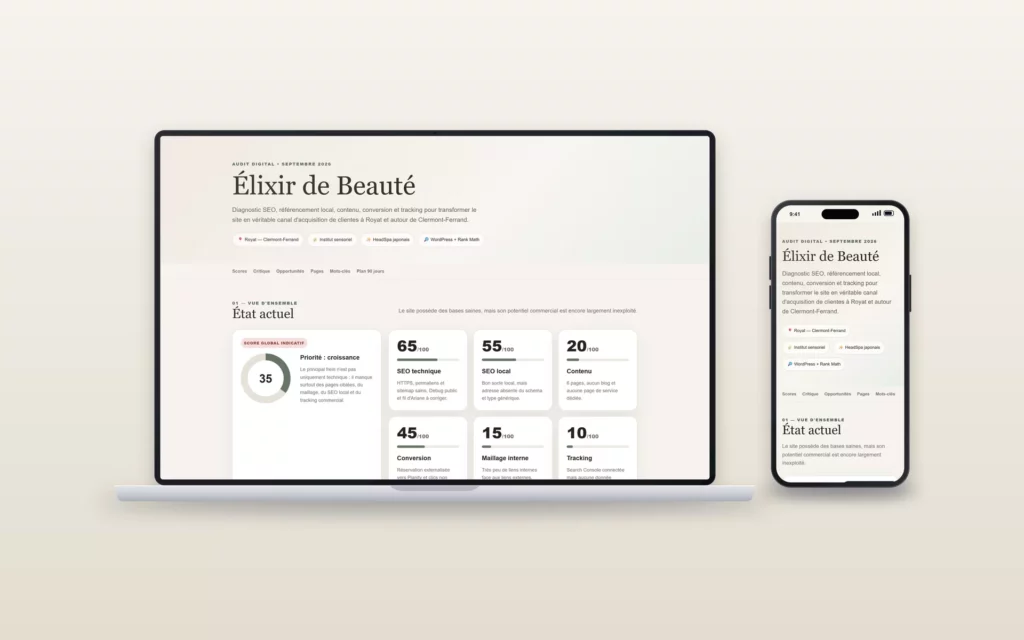
An SEO audit is not a mark out of a hundred. It is a list of findings ranked by impact, each tied to an action. Here is what we check first.
- Indexed pages, and those that should be but are not.
- The title and description of each important page.
- Heading structure: a single main heading, subheadings that describe the content.
- Mobile speed and Core Web Vitals.
- Internal links and orphan pages, which nothing connects to the rest of the site.
- Structured data in place and any errors in it.
- Consistency of name, address and phone across the web.
- The searches that already bring visitors, to build on what works.
Questions people ask about SEO and GEO
Do I have to choose between SEO and GEO?
No. GEO rests on the same foundations as SEO. A well-structured, fast and useful page serves both.
Is SEO only for large companies?
No. A freelancer who clearly describes their services and area can outrank large organisations on precise local searches.
Can you do SEO without a blog?
Yes, to begin with: complete service pages are enough. A blog becomes useful to answer the questions customers ask before buying.
Does Google advertising improve SEO?
No. Paid ads and organic results are two separate systems. Advertising brings visits as long as you pay, SEO builds visibility that lasts.
A short SEO and GEO glossary
- Indexing: storing a page in Google’s database.
- Sitemap: the file listing the pages to crawl.
- Canonical tag: the address of reference when several look alike.
- Hreflang tag: the link between versions of a page in several languages.
- Rich result: a result completed with information from structured data.
- Answer engine: a tool that writes an answer instead of only showing links.
- Core Web Vitals: three measures of real experience on a page.
The SEO list to keep at hand
- Every important page is indexed.
- Every page has its own title and description.
- Every service has its page.
- The site loads fast on a phone.
- Contact details are identical everywhere on the web.
- Structured data describes the business, the services and the frequently asked questions.
- Content starts with the answer and cites its sources.
- Search Console is checked every month.
- Every article points to a service page.
- The number of enquiries received is tracked, month after month.
What this means for a business in Africa or Europe
The rules are the same everywhere, the priorities differ. In Europe, competition on search is dense: a narrow, well-chosen subject and proof of expertise matter most. In West Africa, many sectors still have few well-built sites: a clear business site, a complete Google Business Profile and a few useful pages can be enough to stand out locally. In both cases, mobile comes first, because that is where most visits happen, and loading time on an average connection decides whether the visitor stays.
If you work in both English and French, treat each language as a market in its own right. The questions people ask are not always the same, and neither are the words they use. A page translated word for word will rank less well than a page written for the way people really search in that language.
In short
- SEO remains the base: a page that is indexed, fast and useful.
- GEO adds clarity: direct answers, an identifiable business, structured data.
- Work through the six workstreams in order, then measure the enquiries you receive.
Sources

Written by Amadeus AvlekaFounder of Aureva Digital, designer and web developer based in Cotonou. Learn more